Pushing the decarbonization of aviation sector
- Regional plant scale (30-60-90-120 kt/y of product)
- Modular and scalable design
- Short time to market
- Pool of experts with decades of experience across various sectors
- Possibility to have an end-to-end process, from waste lipids to SAF or RD
In the broad push for the decarbonization of aviation sector, SAF is the only viable solution with HEFA-SAF being the most mature and cost competitive technology for SAF production.
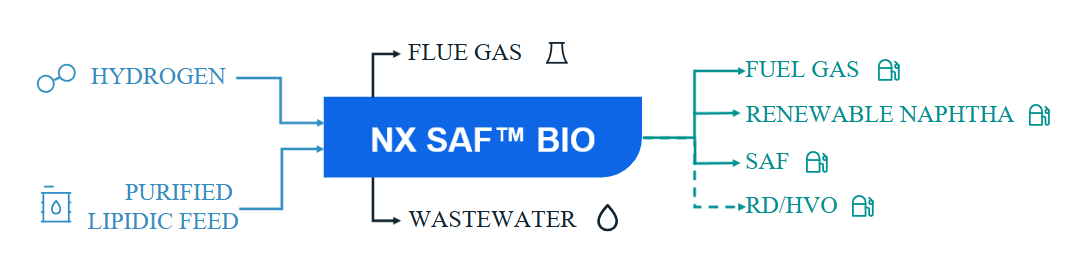
Hydrogenating fats, oils and greases, NX SAF™ BIO maximizes the production of SAF. This technology is offered in 4 sizes at relatively small scale: 30, 60, 90 and 120 kt/y of liquid products.
This solution represents the best available technology for small production of SAF, unlocking the opportunity of a sustainable aviation industry.
This is a modular, fully standardized, flexible solution for the production of low or ultra-low CO₂ SAF.
NEXTCHEM can also offers a fully integrated package which includes Pretreatment Unit (NX PTU), Hydrogen Production Unit and HEFA process (NX SAF™ BIO) for a complete and smooth project deployment.
The technology is able to produce also Renewable Diesel (RD).
Key Benefits of NX SAF™ BIO
- Flexibility of the process (Maximization of highest value fuels, SAF or RD, and possibility to valorize by-products like fuel gas and renewable naphtha)
- Small scale HEFA units enable shorter supply chain, valorizing locally collected feedstocks minimizing transportation
- Possibility to have a single point of accountability (gate-to-gate solution from feedstock to product)
- Pretreatment flexibility (Ability to treat highly polluted and high FFAs feedstocks with low losses and minimal water consumption)
- Short time to market (The high standardization together with the modular solution allow a fast project execution)
- Ultra-low CO₂ SAF (Use of by-products to minimize the carbon intensity score, up to 95% GHGs emission reduction - ultra-low CO₂ SAF)
Where NX SAF™ BIO Fits in
- SAF for Aviation sector according to ASTM D7566
- RD for land and maritime mobility according to ASTM or EN standards
- Renewable Naphtha for biopolymers production
Technical Overview
The process converts, with high efficiency, fats, oils and greases into renewable liquid fuels. To do so, a hydrodeoxygenation step followed by an isomerization and cracking step are required.
By-products, such as fuel gas and renewable naphtha can be recycled to increase the energy efficiency and increase the GHGs reduction.
Whether you're planning a new hydrogen facility, upgrading an existing plant, or seeking low-carbon alternatives, Nextchem provides:
- Technology licensing
- Process design packages (PDP)
- Proprietary equipment
- Digital solutions
- Post-PDP services
Download the leaflet to discover all the key feature about our tecnology.