
A Second Life for Precious Elements
- TBRC smelting above 1200 °C
- Metal purity up to 99.99%
- Recovery losses below 1%
- CAPEX from ~€9M to ~€74M
- Feedstock-tailored furnace recipes
- Flexible wastewater refining align with local rules
Recovering precious metals from waste sounds straightforward, but in practice, the feedstock resists you at every turn. It shows up dirty, mixed and inconsistent, and since most recovery routes are tuned for a single, clean material stream, when the input varies, recovery slips and the economics wobble.
The question is whether a single process can take that messy, variable feedstock and still deliver refinery-grade metal, without a separate plant for every waste type.
The answer is Yes! Our NX Remida technology is engineered for exactly that. It's an integrated pyro + hydrometallurgical technology that recovers copper and precious metals from a wide range of waste streams and delivers ingots up to 99.99% purity, meeting LBMA standards.
The pyrometallurgical front end tolerates heterogeneous material with little preparation; the hydrometallurgical back end does the selective, high-purity separation.
Feedstock
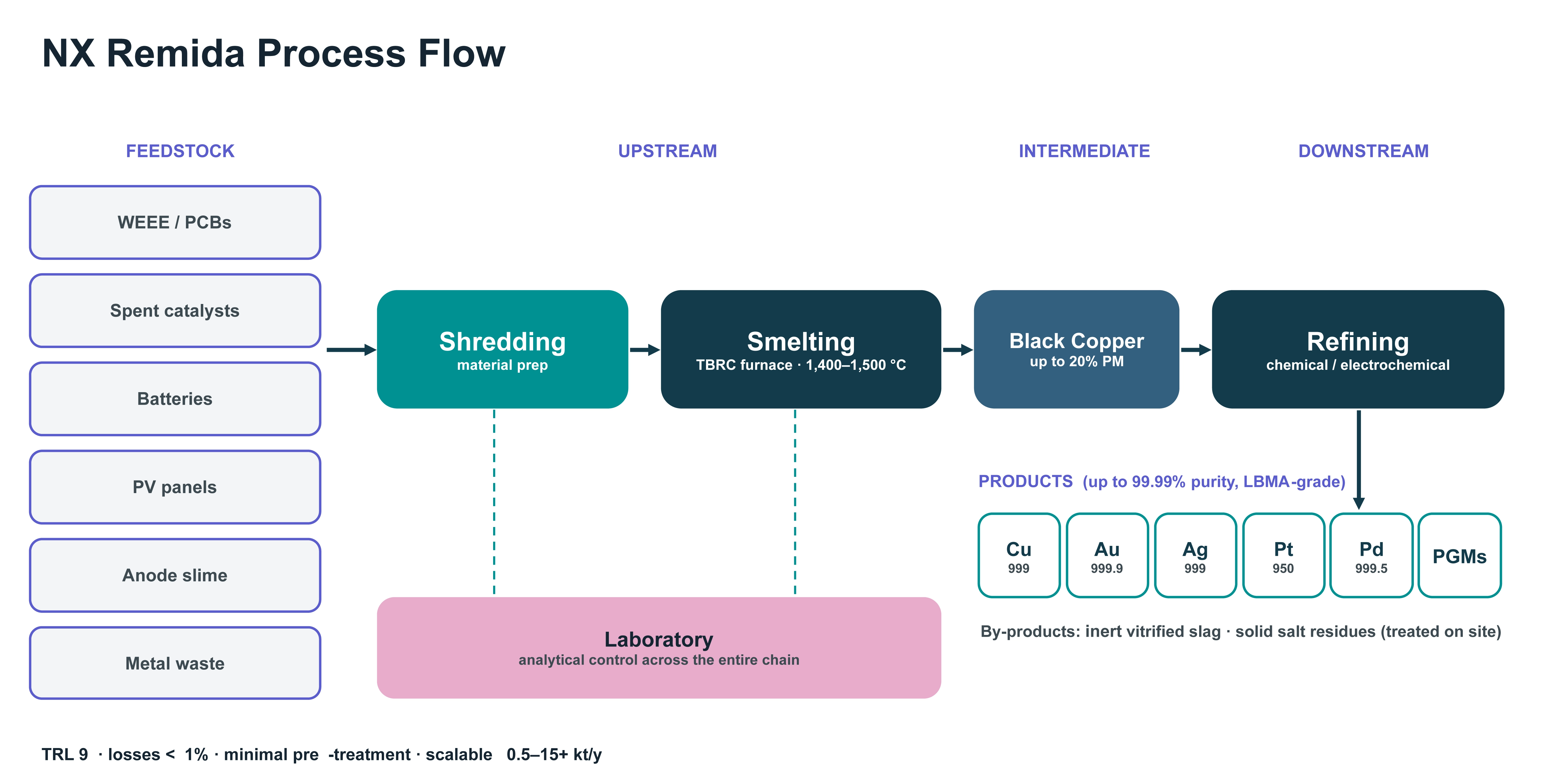
NX Remida is built for heterogeneous, precious-metal-bearing waste, run through a single core flowsheet:
- Waste electrical and electronic equipment (WEEE) and high-value PCBs: the largest and most accessible pool, with the richest fraction sitting in small IT and telecom boards.
- Spent catalysts: low in volume but highly concentrated in platinum-group metals.
- End-of-life lithium batteries: recovering Cu and strategic Li, Co and Ni.
- Photovoltaic panels: beyond being a feedstock, their silicon content makes them well suited to flux formation in the smelting step, so they actively support the process rather than just feeding it.
- Anode slime: a by-product of copper electro-refining, low in volume but highly concentrated in precious metals, and a natural fit for the same recovery line.
- Jewelry scrap and other industrial or medical metal-bearing residues.
Technical Overview
The process runs in two linked stages:
Upstream: Pyrometallurgical
Incoming waste is shredded and compacted, then charged to a Top-Blown Rotary Converter furnace, where it's smelted at above 1,200 °C in batch mode under controlled oxygen conditions.
A siliceous flux is added to form an inert, glassy slag that locks up iron, silicon, lead and other non-target elements.
The target metals collect in a “black copper" phase carrying precious metals, which becomes the feed for refining.
Downstream: Chemical & electrochemical refining
The black copper moves through a controlled sequence:
- Sulphuric-acid leaching dissolves base metals (mainly copper), while the noble metals remain undissolved in solid phase.
- Copper electrowinning recovers high-purity copper from solution.
- Selective dissolution and precipitation, using nitric and hydrochloric acid, separate and purify gold, silver and the platinum-group metals on much smaller volumes.
- Final refining is chemical (e.g. precipitating gold from chloroauric solution with a reducing agent) or electrochemical (for silver and copper), reaching 99.99% purity. Palladium and platinum are refined chemically.
- Refining wastewater can be treated on site depending on local rules.
Output purity, metal by metal
The line doesn't just hit a headline figure, each metal comes off at its own commercial grade: copper at 99, gold at 999.9, silver at 999, palladium at 999.5 and platinum at 9995.
Key Equipment
Behind the two stages sits a defined train of unit operations:
Upstream:
- Feedstock size reduction equipment
- Feedstock handling system
- TBRC Furnace as smelting equipment with its fumes treatment system
Downstream:
- Black copper leaching equipment
- Filtration equipment
- Copper electrowinning system
- TBRC for sludges roasting/smelting
- Waste solutions treatment system
- Recovery and refining units for Gold, Silver and PGM
- Induction furnaces for melting and casting the refined metals into their required shape as grains, ingots or bars.
Plant sizing and utilities
A precious-metals recovery plant is sized around its feedstock, and both its footprint and operating requirements follow from that.
A typical plant occupies about 10,000 sqm, with 30–40% dedicated to warehousing and logistics. Utility requirements depend on the feedstock, target products, plant configuration and local operating conditions, and are therefore assessed during the feasibility study.
The plant configuration can be adapted to the available feedstock and the required processing scope.
The table below provides indicative CAPEX figures for different TBRC models and the corresponding plant yields.
| TBRC model | Plant yield (kg/day) | Total CAPEX, smelting + refining (M€) |
|---|---|---|
| 1,000 | 5,000 | ~9.0 |
| 1,500 | — | ~13.5 |
| 2,000 | 10,000 | ~17.1 |
| 3,000 | — | ~24.1 |
| 5,000 | 25,000 | ~38.2 |
| 10,000 | 50,000 | ~73.8 |
Final figures are confirmed during the feasibility study, against the actual feedstock, target products and local regulations.
Where NX Remida Fits
NX Remida is a fit wherever precious-metal-bearing material is available but under-exploited:
- Waste management companies handling WEEE, incineration residues and mixed industrial waste, looking to valorize streams they already control.
- Established refiners and metallurgical players wanting to revamp or upgrade existing smelting and refining assets.
- New entrants who need a turnkey route into precious-metal recycling.
- Collectors, disassemblers and traders (catalysts, e-waste) pursuing vertical integration and higher value capture.
- Mining companies aiming to recover residual precious metals from tailings and low-grade by-products.
Beyond precious metals
NX Remida goes beyond precious metals. The same TBRC core extends beyond classic e-waste. It can be integrated into copper recovery flowsheets and mining-tailings reprocessing, where copper acts as a carrier metal for precious-metal recovery, opening the technology to secondary copper streams and to residual metals left in tailings.
Ready to explore tailored solutions for your project? Then get in touch with our experts for a feasibility discussion.
NEXTCHEM delivers NX Remida as an end-to-end package, engineering, proprietary equipment and know-how, scaled to what a client already does in-house.
The scope runs from equipment supply (the TBRC furnace plus key smelting, leaching and lab systems) through process integration (the full pyro + hydrometallurgical line, engineered around your feedstock) to 360° technology integration with NEXTCHEM's wider portfolio.
Just as important are the elements that actually decide recovery rates: proprietary furnace recipes tuned per feedstock, analytical know-how for accurate feedstock pricing, and full training and technology transfer so your team can run the plant independently.
Looking for more information or have a project inquiry? Fill out the form to connect with our experts. We will get back to you shortly.