NX STAMI™ Urea Fluid Bed Granulation
High-Performance Urea Granulation for Export-Grade FertilizersEngineered for Global Markets
- Optimized for large-scale fertilizer production
- Minimal formaldehyde consumption
- Extremely low dust generation
- Long on-stream operation (>150 days)
- Advanced low-emission scrubbing system
- High crushing strength and storage stability
Export-oriented fertilizer markets require granules with high crushing strength, low dust generation, minimal caking tendency, and consistent product quality during bulk handling and storage. At the same time, producers must reduce emissions, minimize downtime, and improve plant reliability.
Nextchem's Granulation Design addresses these challenges through a proven fluid-bed granulation technology, developed by Stamicarbon. This technology enables production of high-quality urea granules while maximizing plant performance and minimizing environmental impact.
To deliver reliable long-term operation and reduce formaldehyde consumption, our technology combines:
- advanced spray nozzle design
- optimized fluid-bed granulation
- proprietary scrubbing systems
How Does a Granulation Design Work?
The heart of the granulation is the fluid- bed granulator. Here, urea melt with a urea concentration of 98.5 wt.% is introduced via multiple spray nozzles and deposited on the seed particles/granules in the fluid bed.
The nozzles designed by Nextchem, ensure that the urea melt is sprayed in the form of a film, which has the benefit that only 0.3 wt.% or less of formaldehyde needs to be dosed to the urea melt.
A continuous stream of secondary air is introduced via a ring in each spray nozzle and takes care of the transport of the seeds/granules through the urea melt-film.
Granulation Design The fluid-bed granulator is divided into multiple granulation sections in which urea melt is introduced via nozzles and cooling sections in which the formed granules are cooled down, for further processing.
As the granules move through the granulation section, their size steadily increases by layering until they reach the required granule diameter. Fluidization air is distributed over the granulation sections and cooling sections.
The granules leaving the granulator pass a safety screen (to remove lumps/ agglomerates) and are transported by a bucket elevator to the main screens, where they are separated into three fractions. The in-spec product is cooled and transported to storage.
After cooling and crushing, the coarse product, together with the fines from the main screens, is sent back to the granulator as seed material for granulation.
The fluidization and secondary air are exhausted from the granulator and sent to a dust/ammonia scrubber.
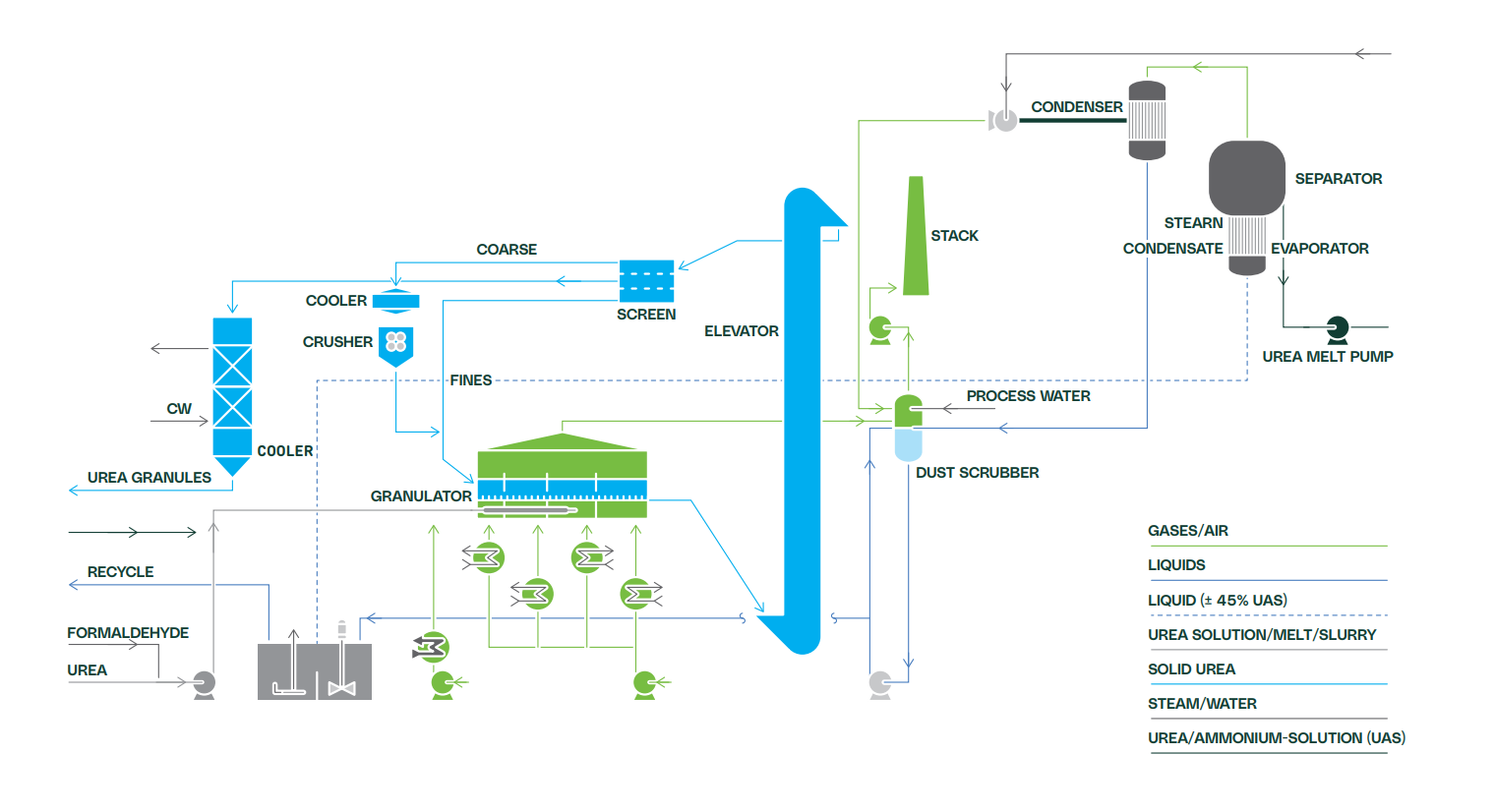
The fluid-bed granulator is divided into multiple granulation sections in which urea melt is introduced via nozzles and cooling sections in which the formed granules are cooled down, for further processing.
As the granules move through the granulation section, their size steadily increases by layering until they reach the required granule diameter. Fluidization air is distributed over the granulation sections and cooling sections.
The granules leaving the granulator pass a safety screen (to remove lumps/agglomerates) and are transported by a bucket elevator to the main screens, where they are separated into three fractions.
The in-spec product is cooled and transported to storage. After cooling and crushing, the coarse product, together with the fines from the main screens, is sent back to the granulator as seed material for granulation.
The fluidization and secondary air are exhausted from the granulator and sent to a dust/ammonia scrubber.
Where Granulation Design Fits In
Granulation Design is developed for:
- large-scale urea production plants
- export-oriented fertilizer facilities
- integrated urea and UAN complexes
- high-capacity fertilizer terminals
- and modernization of existing finishing units
The technology is particularly suitable for producers seeking premium product quality, lower emissions, higher on-stream time and reduced operational downtime.
This design integrates seamlessly with Stamicarbon urea synthesis technologies, UAN production systems, and downstream fertilizer logistics and storage infrastructures.
Whether you're planning to get new facilities, upgrading an existing plant, or seeking low-carbon alternatives, Nextchem provides:
- Technology licensing
- Process design packages (PDP)
- Proprietary equipment
- Digital solutions
- Post-PDP services
Download the leaflet to discover all the key feature about our NX Stami™ Urea technology.
Looking for more information or have a project inquiry? Fill out the form to connect with our experts. We will get back to you shortly.