Looking for more information or have a project inquiry? Fill out the form to connect with our experts. We will get back to you shortly.
Pool Condenser & Pool Reactor Design
Compact, Efficient and Proven by Design for Your Urea PlantOptimized Urea Synthesis Solutions
- Easy and stable plant operation
- Compact, cost-effective and low elevation plant design
- Easier maintenance
- Suitable for low and highest single line capacities
- Significant reduction on corrosion issues
- Well established technology with an extensive proven track record
Selecting the most suitable urea melt technology requires balancing production capacity, investment costs, operational efficiency and plant reliability.
Different project requirements call for different synthesis configurations, particularly when considering plant size, equipment layout and long-term operating performance.
Our Pool Condenser and Pool Reactor Designs provide two proven approaches based on CO₂ stripping technology, allowing producers to select the configuration that best aligns with their capacity targets and investment strategy.
Technical Overview
Both designs are based on the proven CO₂ stripping process, which combines high conversion efficiency with a simplified synthesis configuration.
The process minimizes equipment requirements, reduces maintenance needs and supports stable plant operation.
In the synthesis section, ammonia and carbon dioxide react under high pressure to produce urea. Heat released during carbamate formation is recovered for low-pressure steam generation, supporting overall plant efficiency.
Thanks to the high conversion achieved within the synthesis section, no medium-pressure recirculation stage is required downstream of the high-pressure stripper, simplifying plant configuration and reducing operational complexity.
Pool Condenser Design
This widely used design guarantees optimal heat transfer, excellent process stability and high onstream time. It includes a high-pressure pool condenser combined with a relatively short vertical reactor.
If you want the most efficient technology for capacities from about 2500 up to 6000 metric tons per day (mtpd), this is the best solution!
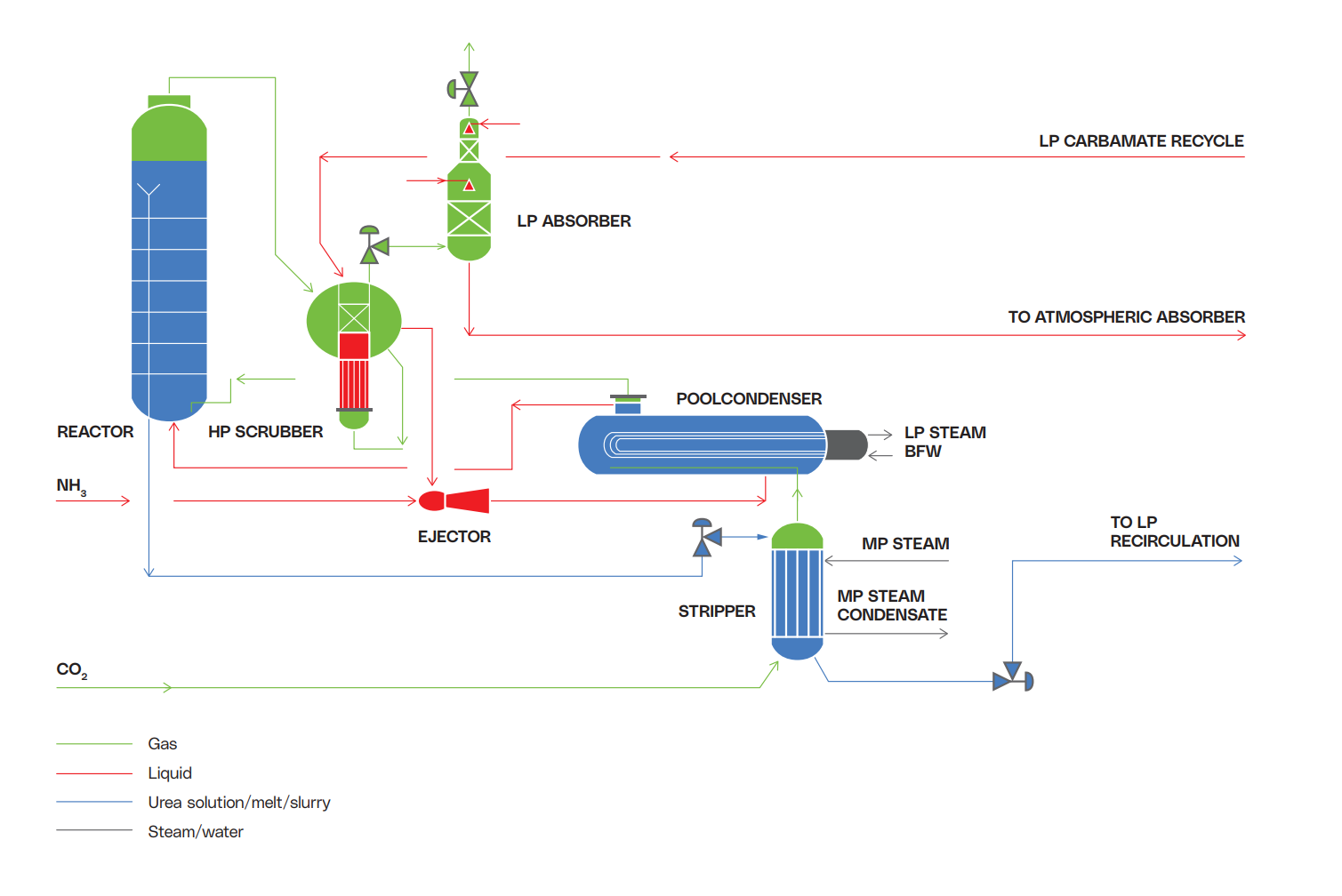
How a Pool Condenser Design Works
Ammonia and carbon dioxide are introduced to the high-pressure synthesis using a high-pressure ammonia pump and a carbon dioxide compressor.
The ammonia then drives an ejector, which conveys the carbamate solution from the high-pressure scrubber to the pool condenser. In the high-pressure stripper, the carbon dioxide, entering the synthesis as a feed, flows countercurrent to the urea solution leaving the reactor.
On the shell side, the high-pressure stripper is heated with steam.
The off-gas of the high-pressure stripper, containing the carbon dioxide, together with the dissociated carbamate, is then fed into the pool condenser, where ammonia and carbon dioxide are condensed to form carbamate.
The heat released by condensation and subsequent formation of carbamate is used to produce reusable low-pressure steam.
After the pool condenser, the remaining gases and a liquid containing urea and carbamate enter the vertical reactor. Here, the final part of the urea conversion takes place.
The urea solution then leaves the top of the reactor (via an overflow funnel) before flowing back into the high-pressure stripper.
Ammonia and carbon dioxide conversions in the synthesis section of a Stamicarbon carbon dioxide stripping plant, are particularly high.
As a result of that, our CO2 stripping process is the only commercially available process that does not require a medium-pressure recirculation stage downstream from the high-pressure stripper. Gases leaving the reactor are fed into the high-pressure scrubber.
Here, the gases are washed with the carbamate solution from the low-pressure recirculation stage.
The enriched carbamate solution is then fed to the high-pressure ejector and, subsequently, to the pool condenser.
Inert gases, containing some ammonia and carbon dioxide, are then released into the 4-bar absorber.
Pool Reactor Design
If you are looking for a low-height plant design with minimal piping and high-pressure equipment, Stamicarbon Pool Reactor Design can provide all you wish for.
Our specific design integrates the pool condenser and a vertical reactor into one piece of equipment: the pool reactor. It is perfectly suited for smaller capacities up to about 2500 metric tons per day (mtpd).
How a Pool Reactor Design Works
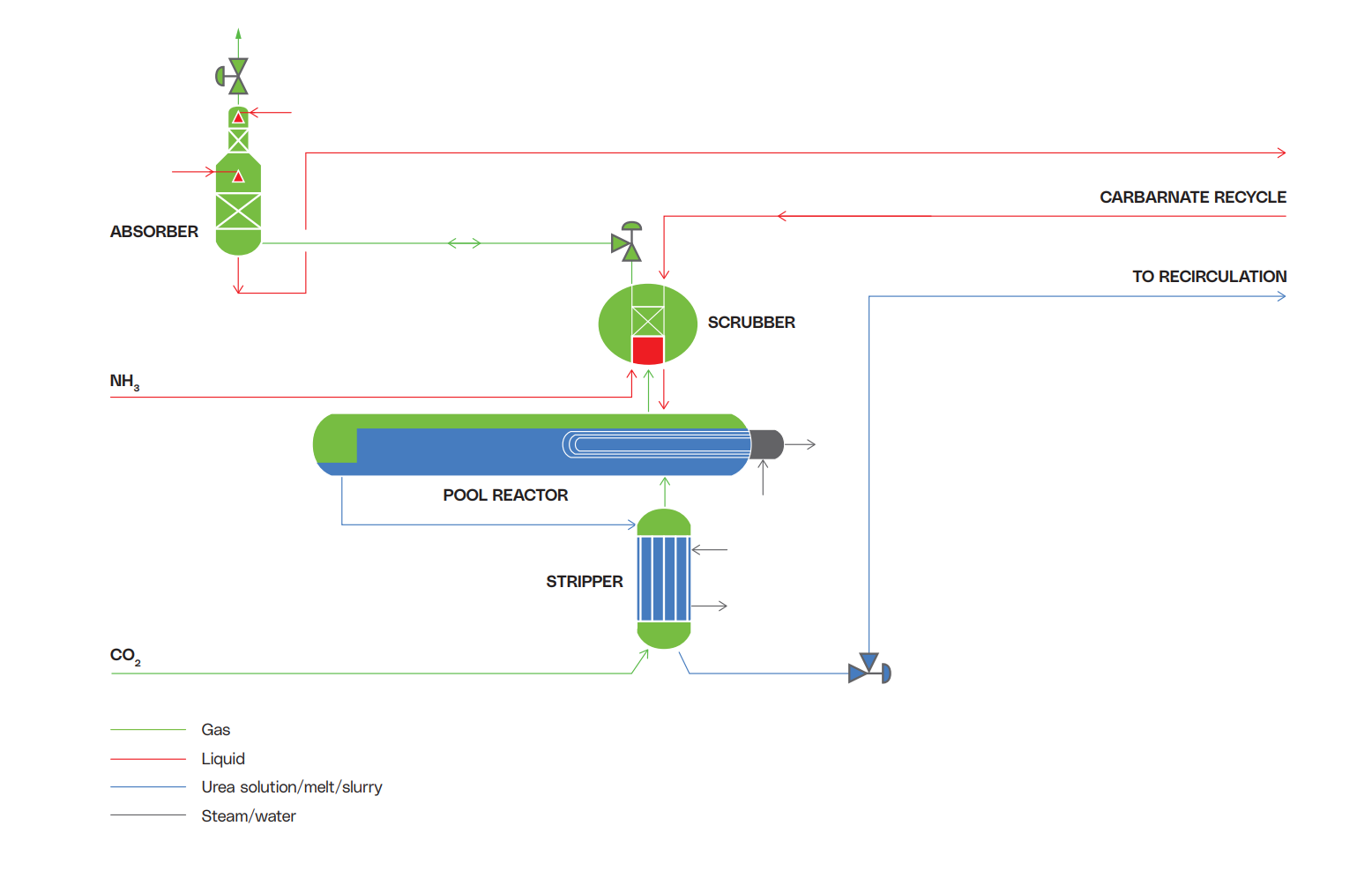
Unlike the Pool Condenser concept, the Pool Reactor concept combines the condenser and reactor in a single pool reactor.
This is achieved by enlarging the horizontal condenser so as to incorporate additional reactor volume.
As a result, it becomes possible to achieve sufficiently high residence times, eliminating the need for a separate vertical reactor, while creating the conditions that will allow the reaction to reach its optimum condition with the advantage of having a plant height of about 30 meters.
The high-pressure scrubbing operation can also be simplified in the Pool Reactor concept by placing the scrubber sphere above the pool reactor and adding the ammonia to the synthesis via this scrubber.
This ensures that no separate heat exchanging section in this scrubbing operation is required. In the Pool Reactor concept, carbamate from the low-pressure recirculation section flows together with the absorbed gases and the ammonia into the pool reactor.
As the static liquid height ensures gravity flow, no high-pressure ejector is needed.
Optimized Design for Different Production Needs
Both synthesis concepts are based on the same proven process principles and share the advantages associated with CO₂ stripping technology, including high conversion efficiency, effective heat integration and a simplified synthesis loop.
The Pool Condenser Design is generally selected for larger-capacity plants where maximum production rates, robust heat-transfer performance and established large-scale operation are the primary objectives.
The Pool Reactor Design, on the other hand, offers a compact alternative for smaller-capacity facilities seeking reduced plant height, simplified piping arrangements and lower high-pressure equipment requirements.
The final selection depends on project-specific factors such as capacity targets, site conditions, investment priorities and operational preferences. In both cases, the synthesis section is designed to deliver reliable long-term performance with a streamlined process configuration and high operational stability.
Whether you're planning to get new facilities, upgrading an existing plant, or seeking low-carbon alternatives, Nextchem provides:
- Technology licensing
- Process design packages (PDP)
- Proprietary equipment
- Digital solutions
- Post-PDP services
Download the leaflet to discover all the key feature about our NX Stami™ Urea technology.
Learn more about who we are, how we began, and why we're committed to enabling the energy transition.
Go to About Us Go to About UsDiscover the sustainable technology solutions and integrated E&C solutions our Group offers.
Go to Solutions Go to SolutionsExplore our open positions to find your perfect match and learn more about our Group culture.
Go to Careers Go to Careers See Open Positions See Open PositionsFind the latest news and media resources about our Group, companies, people.
Go to Newsroom Go to NewsroomRegistered Office: Via di Vannina 88/94, 00156 Rome, Italy
P: +39 06 9356771
Company subject to direction and coordination of MAIRE SpA
Share capital € 32.938.653,00 fully paid-up
Tax Code, VAT number and Rome Company register number 16951401005
R.E.A. 1686636